


 Sashidaran Gunathevan
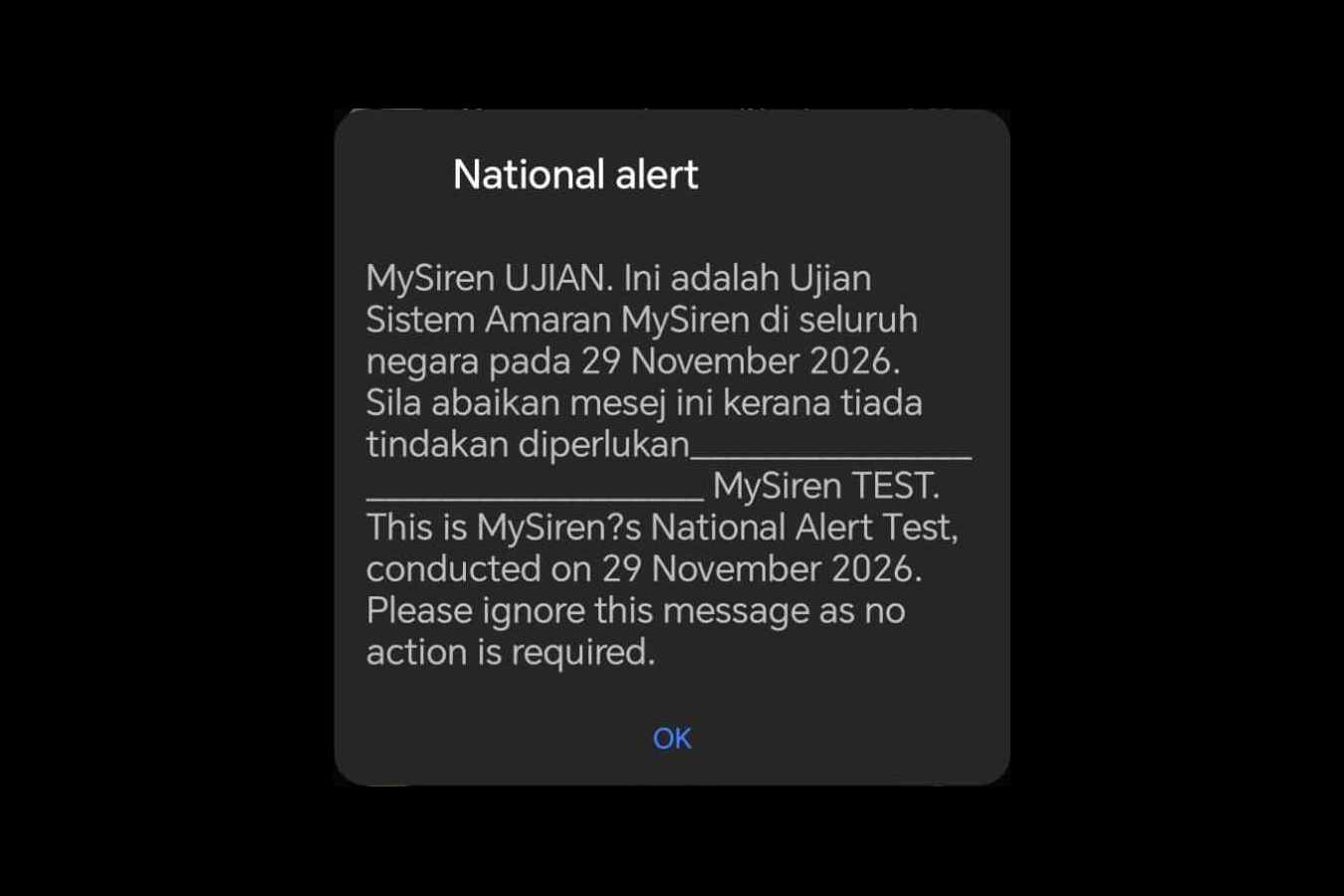
The MySiren nationwide test ran on Sunday, 29 November, from 10.10am to 10.30am. The Malaysian Communications and Multimedia Commission (MCMC) used the 20 minutes to test how fast alerts reach phones. It came after a 19 November mix-up over an internal test.
MySiren is the National Early Warning System. It uses Cell Broadcast System (CBS) technology. This reaches compatible phones in the area at risk. The alerts travel over 4G and 5G and use no mobile data.
The test alert reached at least one Android phone at 10.10am, headed “National alert”. The message came in Malay, then English, and asked people to ignore it because no action was needed. While it showed on screen, a female voice read it aloud. On this phone, the Malay text came out with an English accent. If yours stayed silent, MCMC says to update it and check its alert settings.
Phones that can receive MySiren alerts
MCMC lists the software a phone needs. iPhone 11 and newer models need iOS 27.2 or later. Android phones need Android 12 or later, and these requirements remain subject to final technical verification.
Huawei phones need EMUI 16 or later. Phones that use only 2G or 3G will not get MySiren alerts. Some older 4G phones may miss them too.
That matters because the alert depends on the handset. If a phone has no cell broadcast support, it may stay silent, according to Newswav.
Meanwhile, MCMC urged people to tell their families about the test. Older relatives may be startled when a phone sounds off without warning, the commission said.
How MySiren alerts reach your phone
MySiren broadcasts from mobile towers to every compatible phone in a set area. Unlike SMS, it does not send to individual phone numbers. So an alert can still arrive during network congestion or after a data quota runs out.
The system does not access personal data on the phone, and recipients pay nothing. Since it needs no app, users do not have to install or sign up.
Read more: Malaysia sets 29 Nov emergency alert test after 19 Nov mix-up
Read more: Selangor has 122 flood warning sirens, the most of any state
Read more: DBKL flood warning now comes one hour early, not five minutes
Disaster agencies can issue six types of alert. They are National, Extreme, Severe, Missing Person, Test and Exercise. The type depends on how serious the emergency is.
After the MySiren nationwide test, the system is meant for severe weather, floods, tsunamis, major fires and hazardous material incidents. MCMC runs it, and the police, Nadma and local authorities also have access. Flood-prone states use sirens too, such as Selangor’s 122 flood warning sirens.
What to do if the MySiren nationwide test missed you
MCMC advises updating the phone’s software and restarting it. Users should also make sure emergency alerts are switched on. The commission said it would publish settings guides for Android and iOS users.
For updates, MCMC points users to www.mcmc.gov.my/mysiren. It also points to its own channels and those of Nadma.
Still, the public test does not mean MySiren is fully operational yet. MCMC expects the system to go live by the end of 2026, including heavy rain warnings.
The system took RM200 million to develop, with work starting in 2025. Until live alerts begin, check official channels for flood and weather warnings.






 Yalinie Mathan
 Amirull Salihing





Add comment