
Malaysia’s coffee culture does not begin at Starbucks. It does not begin at ZUS Coffee either. It begins in 1799 — when the first coffee plants took root in Johor and the Malay Peninsula. That was centuries before the nation itself existed.
Today, that same culture drives a market worth USD 753 million, with 3,300 branded coffee chain stores and a wave of Chinese chains rewriting the rules of Malaysian coffee.
The answer runs through colonial tea rooms, mamak stalls, cloth sock filters and Tongkat Ali sachets at local warungs. It runs through a Perak town that made its coffee world-famous. And a pandemic that accidentally built the most aggressive domestic coffee industry in the world. Malaysian coffee culture is not one thing. It never was.
The land that grew coffee before it became famous for tea

Malaysians have been growing coffee since 1799, particularly across West Peninsular Malaysia and East Malaysia. By the 19th century, the crop had firmly established itself in Johor, Negeri Sembilan and Malacca.
The British expanded coffee plantations to diversify agricultural production. Johor grew Liberica — the rarest of the four main coffee species. It has a fruity, woody flavour profile that neither Arabica nor Robusta can replicate.
But rubber came for coffee first. Then oil palm came for rubber. Between 2010 and 2018, Malaysia’s coffee harvested area contracted by 13% per year on average. Production fell by 16% annually. Farmers found that oil palm simply paid better per hectare. The industry shrank fast.

Survival shaped something remarkable. Sabah’s Tenom district still wears the crown as the coffee hub of Sabah. The Fatt Choi Coffee Factory there lets visitors see the full production process — from handpicked cherries to packaged powder.
In Perak, the Antong Coffee Mill in Taiping is Malaysia’s oldest. It is still open to the public with free guided tours and wood-fired roasting. In Johor’s Batu Pahat, family-run Liberica plantations have started opening for agritourism.
Ipoh earned recognition as one of the top three coffee destinations in Asia by Lonely Planet’s Global Coffee Tour. Not for its farms, but for its white coffee.
Palm oil margarine replaces sugar in the roasting process — giving the beans a lighter colour and a taste all their own. That local method became a national product when OldTown White Coffee took it to shopping malls. A town’s morning ritual became a billion-ringgit brand.
What kopi kampung actually is — and why it is still irreplaceable

Malaysian roasters double-roast their robusta and liberica beans. First in the usual way. Then they mix them with melted butter and sugar until caramelised, before grinding and cooling. No other country roasts coffee this way. The result is bold, slightly burnt, nutty and sweet. But how that coffee reaches the cup depends entirely on where you are drinking it.
In the warung — the village coffee stall of rural Malaysia — the method follows the Indonesian kopi tubruk tradition. The brewer pours hot water directly onto coarsely ground coffee powder in the glass. No straining. No filter. You wait for the grounds to settle before drinking.
Brands like Kopi Cap Kapal Api are made for exactly this method. If the grind is too coarse, you taste the husk. The texture is thick and heavy. That is not a flaw — it is the character of warung coffee.
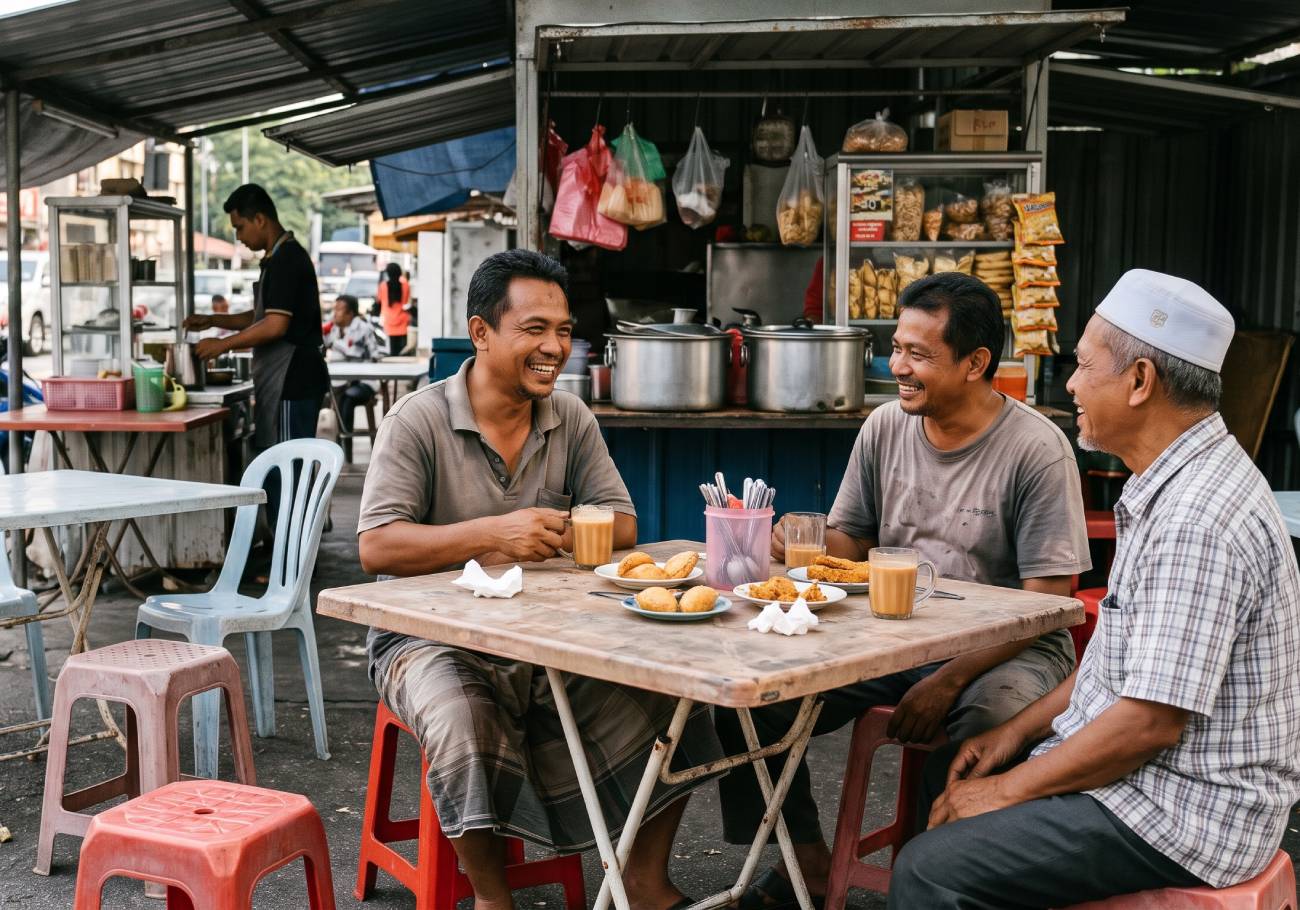
The kopitiam does it differently. Chinese community-run coffee shops use finer-ground coffee brands like Aik Cheong and Chek Hup. The barista packs the grounds into a cloth sock filter and pours hot water through it slowly. The result is cleaner, smoother, without sediment.

The mamak stall sits somewhere between both worlds. It often uses the sock method but with its own preferred blends and a heavier pour of condensed milk. Three communities, three variations on the same bean, three distinct tastes in the cup.
Malaysians consumed 48 million kg of coffee every year in 2021 and 2022. Much of that passed through a warung glass or a kopitiam sock. The variations extend beyond brewing method too.
Kopi O is black with sugar. Kopi O Kosong is black without. Kopi C uses evaporated milk instead of condensed. Kopi Tarik is pulled between two vessels to create froth. Each variation has its own kind of drinker. Ordering the wrong one at a proper kopitiam still gets you a look.
In urban areas, Nescafe 3-in-1 sachets filled the same role. Hot water, a sachet, done. Then Nespresso arrived with capsule machines. The at-home cafe experience became available without leaving the kitchen.
By 2025, companies like Lavazza were selling capsules aggressively through Shopee and Lazada. ZUS Coffee had launched its own pods for home use too. The warung glass, the kopitiam sock and the Nespresso capsule now all coexist in the same country.
Kopi Kuat and the aphrodisiac coffee economy

There is a category of Malaysian coffee that does not appear on cafe menus. It has no ZUS equivalent. It sits at the counter of warungs and mamak stalls. It is sold at rest area stalls along highways, in night markets and roadside shops. Long-haul drivers are its core market. It is called Kopi Kuat, Kopi Jantan, or variations on the theme — and its active ingredient is not caffeine.
Tongkat Ali, or Eurycoma longifolia, is a native Malaysian root plant. It has a long history of traditional use as a male vitality tonic. Blended into coffee with ginseng and other herbs, it became a rest area staple.
Men on long haul drives or night shifts reach for it first. The market for these blends runs into hundreds of millions of ringgit annually. It is a genuinely Malaysian coffee innovation — born from kampung herbal tradition, not third-wave culture.
The product sits in a regulatory grey area. It is sold as a food product, not a supplement. Health claims are technically restricted. Yet the marketing is unmistakable.
Names like Kopi Jantan and imagery of tigers and mountains leave little to the imagination. The products sell regardless. They are exported across Southeast Asia and the Middle East, where Malaysian herbal products have built a strong following.
It is not the coffee story that gets written about in lifestyle magazines. But it is a genuine piece of Malaysian coffee culture — perhaps the most uniquely local piece of all.
From Starbucks boycott to Southeast Asian dominance: the franchise explosion

The indie cafe era in Malaysia began around 2010. Millennials returned home after studying abroad and saw an opportunity. Third-wave coffee came to TTDI and Mont Kiara. Pour-over, single origin, Arabica beans in small, carefully designed spaces with good Wi-Fi. Coffee became something you photographed before you drank. That shift changed what Malaysians expected from a cup.
Then ZUS Coffee launched in November 2019 from a 19-square-metre kiosk at KLCC. No seating. App-first. Grab and go. By early 2026, there were over 700 ZUS Coffee locations across Malaysia. It became the largest homegrown coffee chain in the country by outlet count. The model was deliberately anti-Starbucks — smaller, cheaper, faster, digital.
ZUS Coffee was among several Malaysian chains to surge after the worldwide Starbucks boycott in late 2023. The boycott was triggered by the brand’s association with the Middle East conflict.

What started as a geopolitical response became a structural shift. Malaysian consumers discovered that ZUS, Gigi Coffee and Bask Bear served comparable drinks at 20 to 30% lower prices. Many never went back. By 2026, there were 3,300 branded coffee chain stores in Malaysia.
Then came Luckin Coffee. The Chinese chain opened its first two outlets in Kuala Lumpur in January 2025 — its second international market after Singapore. To mark the launch, beverages were priced as low as RM2.99 through its app.
A Starbucks Americano costs about RM11. The plan is 200 stores across Malaysia within a few years. It partnered with Bursa-listed Hextar Industries for halal certification and local credibility.
Vietnamese drip coffee shops also quietly appeared in KL, Penang and Johor Bahru. Southeast Asia’s modern coffee and tea market was valued at USD 9.9 billion in 2025, up from USD 8.3 billion in 2023. Malaysia sits at the centre of that growth.
What teh tarik tells us about where coffee stands now

For all the franchise expansion and capsule machines, teh tarik has not gone anywhere. The pulled tea remains the great Malaysian equaliser. It is made with black tea and condensed milk, poured between two vessels to create froth. Every ethnic community drinks it. Every mamak stall serves it. It costs less than a ZUS oat milk latte. It requires no app.
But teh tarik’s territory has been expanding, not shrinking. Bubble tea arrived from Taiwan in the late 1990s and swept through Malaysian night markets in the early 2000s. Chatime formalised the market when it entered in 2010. Seven years later, Loob Holdings lost its Chatime franchise licence and rebranded every outlet as Tealive rather than shut down.
That accidental rebirth produced Malaysia’s most successful homegrown bubble tea brand — at its peak serving 1.2 million cups and generating over RM100 million a year. Boba did not replace teh tarik. It pulled up a chair next to it, drawing a younger generation raised on Instagram and chewy tapioca pearls.
Then the Chinese chains arrived to challenge both. Chagee opened its first Malaysian outlet in August 2019 and by 2024 had over 150 stores here — positioning itself as a premium tea house with modern Chinese aesthetics. Mixue targeted the budget end with low prices and high volume.

Newer Chinese brands began outpacing the Taiwanese and local chains that once dominated the market. Meanwhile, chai latte — spiced milk tea with South Asian roots — quietly appeared on cafe menus across the country. It bridges the gap between mamak tradition and third-wave cafe culture.
The coexistence of teh tarik, boba, chai latte, Chinese milk tea and third-wave coffee tells you something important. Malaysia was once a predominantly tea-drinking country shaped by British colonialism. The shift towards coffee came through the younger generation and their exposure to the internet and western lifestyle. But that shift did not erase what came before. It layered on top of it. Then boba layered on top of that. Then Chagee layered on top of boba. The cup keeps getting more interesting.
Old and new Malaysian drinkers differ in their choices of variety and flavour. Their relationship with the drink itself is the same. The uncle drinking kopi O from a ceramic cup at a kopitiam is a coffee drinker. So is the graduate ordering a cold brew on the ZUS app. And the teenager waiting in line for brown sugar bubble tea is reaching for the same thing both always were — something warm, sweet and deeply Malaysian. The culture contains all of them without contradiction.
The Malaysian coffee market is projected to grow from USD 753.8 million in 2024 to USD 1.075 billion by 2030. Somewhere in that trajectory, a kampung roaster is still caramelising robusta beans in a wok with butter and sugar. And somewhere else, a barista dials in a single-origin Sabah Arabica on a pour-over. The cafe opened last year. That is Malaysian coffee culture. It never moved in a straight line.


Add comment